
Class A ELDT in Missouri - CLP, ELDT Hours & Skills Exam Steps
A Class A Commercial Driver’s License is the credential that opens the door to operating the biggest and most in-demand commercial vehicles on the road. With a Class A CDL, you can legally drive:
- Tractor-trailers and 18-wheelers
- Flatbeds and dry vans
- Tankers and many combinations over 26,001 lbs with a trailer over 10,000 lbs
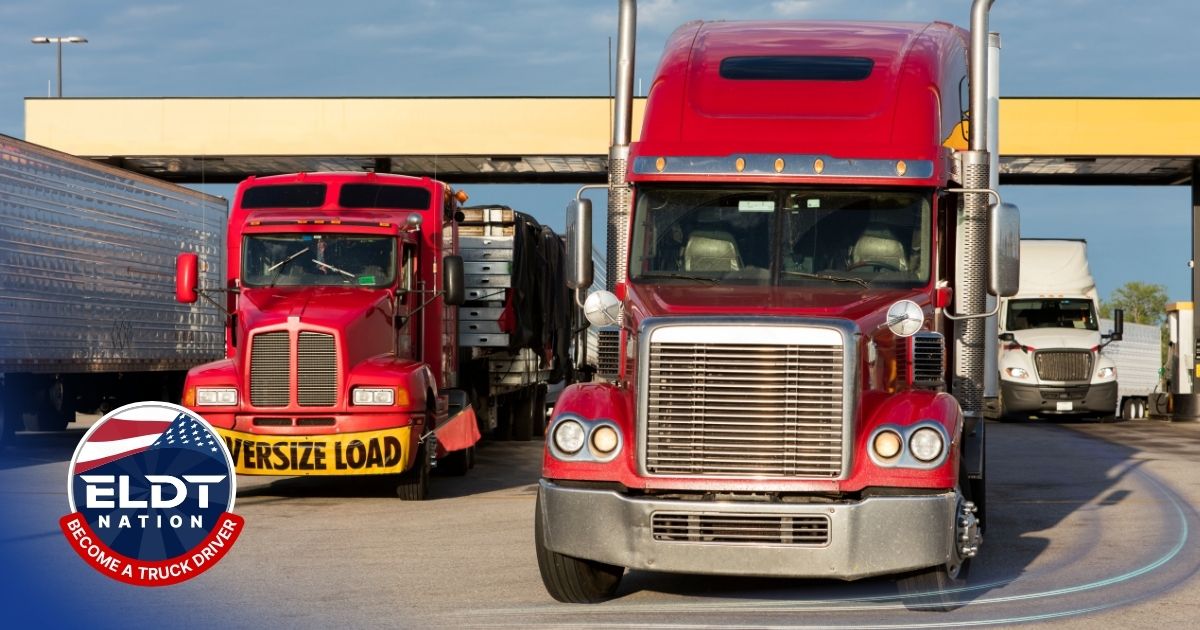
Class A ELDT & CDL in Missouri: the big picture
What is Class A ELDT (Entry-Level Driver Training)?
Entry-Level Driver Training, or ELDT, is the federally mandated training standard for new commercial drivers. Since February 7, 2022, anyone who wants to:
- Obtain their first Class A or Class B CDL
- Upgrade from Class B to Class A
- Add certain endorsements (such as Hazmat, Passenger, or School Bus)
must complete ELDT with a provider that is registered in FMCSA’s Training Provider Registry (TPR).
For a Class A CDL applicant in Missouri, ELDT has two distinct parts:
Theory (knowledge) training
This is the classroom portion of your training, which can be delivered online. It covers topics such as:
- Basic vehicle control and handling
- Combination vehicle dynamics
- Air brake systems and inspections
- Cargo securement and weight distribution
- Hours-of-service basics and logbook principles
- Safe driving practices in traffic, on grades, and in bad weather
ELDT Nation delivers this theory portion entirely online, through structured video lessons, quizzes, and text explanations. Once you pass the required assessments, your completion is reported electronically to the FMCSA TPR, so Missouri examiners can verify that you are ELDT-compliant before your skills test.
Behind-the-wheel (BTW) training
Behind-the-wheel training is the hands-on component you complete with a CDL school or training provider using an actual commercial vehicle.
BTW training includes:
- Range practice (backing, coupling, uncoupling, tight-space maneuvers)
- On-road driving in real traffic, including interstates, city streets, and rural roads
- Applying what you learned in theory: pre-trip inspections, air brake checks, safe following distances, speed control on grades, and more
Missouri does not allow BTW training to be done online. It must take place in person, in a real truck, with a qualified instructor. However, completing high-quality online theory first dramatically shortens the time it takes you to feel comfortable when you step into the truck.
Together, theory and BTW ELDT make up the training foundation that Missouri requires before you can sit for the CDL skills exam.
Who needs Class A ELDT in Missouri
Can I do Class A ELDT Training online in Missouri?
What you can do online: theory training
For the theory portion of ELDT, Missouri allows you to use any training provider that is properly registered in FMCSA’s Training Provider Registry. That includes online providers, as long as they meet every federal content standard and follow the TPR reporting requirements.
This is exactly where ELDT Nation fits into your Missouri training plan.
With ELDT Nation’s Class A ELDT theory course, you can:
- Enroll online and begin lessons immediately, without commuting to a classroom
- Watch structured video modules that break down each concept into plain language
- Use interactive quizzes to check your understanding as you go
- Revisit difficult topics as many times as needed, with unlimited access until you pass your assessments
- Learn at your own pace around work, school, or family obligations
Because the course is FMCSA-approved and listed in the Training Provider Registry, your completion is:
- Recorded electronically
- Reported directly to FMCSA
- Visible to Missouri CDL examiners when they check TPR status before scheduling or conducting your skills test
That means you can finish all theory requirements from home, on your own schedule, while still being fully aligned with Missouri’s CDL process.
What you cannot do online in Missouri
It is equally important to understand what cannot be done online.
In Missouri:
- CDL written knowledge tests for your CLP must be taken in person at a Missouri State Highway Patrol Driver Examination Station.
- The tests are administered only in English.
- Translators are not allowed for CDL knowledge tests.
- You must physically appear at an exam station, present your identification and other required documents, and take the test on their system.
- The CDL skills exam must also be completed in person at an approved Missouri State Highway Patrol CDL test site or with a certified third-party examiner.
- You must provide a suitable test vehicle that matches the class of CDL you seek (a Class A-appropriate combination, if you are testing for Class A).
- You must demonstrate pre-trip inspection, basic control maneuvers, and safe operation in real traffic.
- Behind-the-wheel (BTW) training, which is part of ELDT, cannot be simulated online.
- It requires real driving experience with a qualified instructor in the truck.
- Missouri’s skills examiner will expect to see that you can apply theory in the real world, not just recite concepts from a screen.
Online training completely covers your federal theory requirements, but it does not replace Missouri’s in-person testing and on-road experience. Think of online ELDT as the backbone of your knowledge, not as a shortcut around the legal requirements.
.jpg)
ELDT: federal rules vs Missouri specifics
Federal ELDT and CDL framework that also applies in Missouri
No matter where you test, the federal framework for ELDT and CDL issuance sets the minimum steps you must follow. For a new Class A driver, those steps can be summarized as:
- Obtain a valid Commercial Learner’s Permit (CLP) after passing the required written knowledge tests
- Hold the CLP for at least 14 days before taking the CDL skills exam
- Complete ELDT for the correct license class and any endorsements you are pursuing
- Pass the CDL skills exam, which includes:
- A vehicle inspection (pre-trip) segment
- Basic control skills (backing and maneuvering)
- An on-road driving test in real traffic
These requirements are not optional in Missouri. The state must enforce them as a condition of being allowed to issue CDLs at all.
The ELDT rules also specify:
- What topics must be covered in theory training
- What competencies must be demonstrated on the range and on the road
- How providers must track and report student performance
Because ELDT Nation is built specifically around these federal standards and approved in FMCSA’s Training Provider Registry, you do not have to worry about whether your training “counts” in Missouri. Once you complete the course, it counts everywhere.
Missouri-specific CLP rules you need to know
Where Missouri steps in is in the detailed implementation of CLPs and CDLs. Before you can benefit from ELDT or the skills exam, you first need a Missouri CLP that is properly issued.
Key points include:
Age requirements
- At 18 years old, you can hold a Missouri CLP and later a CDL that authorizes you to operate commercial vehicles within Missouri only (intrastate).
- At 21 years old, you may operate interstate, carry certain types of passengers, or transport hazardous materials, as long as you meet all other federal and state requirements.
If you are between 18 and 20, you can absolutely start your Class A journey, but your job options will be intrastate until you turn 21.
Knowledge tests and vision standards
Before a CLP is issued, Missouri requires you to:
- Pass the appropriate written knowledge tests for:
- General commercial knowledge
- Combination vehicles
- Air brakes (if the vehicle you will test in has air brakes)
- Any endorsements you are pursuing (for example, Tank or Hazmat theory)
- Meet the state’s minimum vision standards, which generally require at least 20/40 vision in one or both eyes, with or without corrective lenses, plus adequate peripheral vision.
If you need corrective lenses to meet this standard, you may receive a restriction on your license that requires you to wear them whenever you drive.
CLP holding period and use
Once you pass the written tests and receive your Missouri CLP:
- You must hold the CLP for a minimum of 14 days before you are eligible to take the CDL skills test.
- During that period, you can practice driving a Class A vehicle, but only:
- With a qualified CDL holder in the front seat next to you
- In a vehicle of the appropriate class and configuration
This 14-day period is a federal requirement, enforced by Missouri, meant to ensure that you do not go straight from a written test to a full CDL without any practical exposure.
CLP fees and payment structure
When you go to a Missouri contract license office to secure your CLP, you will pay a combined fee that is typically around the mid-forties in dollars. This fee usually includes:
- A written examination test fee
- A permit transaction fee
- An office processing fee
Exact amounts can change over time, but the important point is that you should come prepared to pay for both the testing and issuance of the CLP itself. Later, when you upgrade to a full CDL after passing the skills test, you will pay a separate CDL issuance fee that covers the skills test, license term, and processing.
Missouri’s modernized CDL skills test since December 2023
Missouri does not just follow federal minimums; it also stays in step with national modernization efforts. One of the most important changes for new drivers is the adoption of the modernized CDL skills test.
As of early December 2023, Missouri transitioned all state and third-party CDL skill examiners to this updated model. For you as a test-taker, this affects:
- Pre-trip vehicle inspection
The inspection is more streamlined and better aligned with current commercial vehicle technology. Instead of feeling like a long checklist from decades ago, it focuses on critical safety items that modern trucks actually use every day. - Basic control skills (backing and maneuvers)
Backing exercises are restructured to better reflect the way drivers actually maneuver on docks, in yards, and in tight job sites. The maneuvers are still demanding, but the layout is designed to test practical control, not obscure tricks. - On-road driving
The road test remains a comprehensive evaluation of your ability to safely operate a commercial vehicle in real traffic, but the scoring and structure are aligned with updated guidance from the American Association of Motor Vehicle Administrators (AAMVA).
For you, the main takeaway is this:
- Missouri will test you on the modern standard, not the old one.
- Your training provider must teach you in a way that matches this new model.
- High-quality theory training, like ELDT Nation’s course, should help you understand not just what to do during the exam, but why those actions matter for safety and compliance.
When you look at the Missouri CDL manual, you will see that sections dedicated to skills testing have been updated to reflect the modernized test. Make sure you are studying the version that applies to your planned test date, not an outdated manual you found online.
The 2025 pause on non-domiciled CLP/CDL issuance in Missouri
There is one more Missouri-specific detail that matters, especially for people who are not clearly Missouri residents.
What “non-domiciled” CLP/CDL means
A “non-domiciled” CLP or CDL is a commercial credential issued by a state to a person whose true, fixed, and permanent home is in another jurisdiction, often another country.
Examples include:
- Certain foreign drivers temporarily working in the United States
- Individuals whose primary residence is not in Missouri but who seek a Missouri CDL for work reasons
Because of federal concerns about how non-domiciled licenses are verified and tracked, FMCSA issued updated rules that directly affect states such as Missouri.
Missouri’s response: suspension of non-domiciled CLP/CDL issuance
In response to an FMCSA interim final rule on non-domiciled credentials, Missouri announced that, effective late September 2025, it was suspending:
- All new non-domiciled CLP and CDL issuances
- Renewals and duplicate issuances for non-domiciled commercial credentials
- Associated knowledge and skills testing for applicants who would be restricted to non-domiciled status
This is a technical but important change. It does not affect the typical Missouri resident who lives, works, and pays bills in Missouri. It mainly affects applicants whose legal domicile is outside Missouri and who would normally receive a CDL or CLP marked as non-domiciled.
Because federal guidance, litigation, and state-level responses can evolve, anyone who thinks they might fall into a non-domiciled category should:
- Verify current rules directly with the Missouri Department of Revenue and/or their legal advisor
- Clarify how their immigration or residency status affects their CDL path
- Avoid assuming that Missouri can issue them a non-domiciled CDL simply because another state did so in the past
Step-by-step: getting your Class A in Missouri
Entering commercial trucking in Missouri is a structured process governed by both federal FMCSA rules and Missouri Department of Revenue (DOR) requirements. The steps below walk you through the journey from holding no CDL at all to earning a full Class A license that allows you to drive tractor-trailers and combination vehicles on the nation’s freight corridors.
This roadmap focuses specifically on Missouri residents who plan to test and obtain their CDL through the Missouri State Highway Patrol (MSHP) and DOR licensing system.
Step 1 – Confirm eligibility
Before preparing for tests or training courses, Missouri requires you to meet basic eligibility conditions. These rules determine whether you can legally obtain a Commercial Learner’s Permit (CLP) and later a Class A CDL.
Age requirements
Missouri follows the federal age framework:
- 18 or older to drive commercially inside Missouri only (intrastate)
- 21 or older to drive outside the state, transport certain passengers, or haul hazardous materials
This means applicants between 18 and 20 can earn a Class A CDL in Missouri but will be restricted to intrastate driving until they turn 21.
Valid Missouri driver’s license and lawful status
To apply for a CLP, you must:
- Hold a valid non-commercial Missouri driver’s license
- Provide acceptable proof of lawful permanent residency or citizenship
- Submit documentation showing your legal name, date of birth, and citizenship or immigration status
Acceptable documents are verified at any Missouri contract license office based on state standards.
Social Security number and Missouri residency
Missouri requires:
- A valid Social Security number (SSN)
- Two acceptable documents proving Missouri residency
These must clearly show your name and physical address. Acceptable examples typically include lease agreements, utility bills, letters from state agencies, insurance documents, or bank statements.
DOT medical requirements for most drivers
Many Class A applicants will need a Medical Examiner’s Certificate (MEC), often called a DOT Medical Card. It is issued after a DOT physical performed by a certified medical professional. You must self-certify the type of commercial driving you intend to perform:
- Non-excepted interstate (requires MEC)
- Non-excepted intrastate (requires MEC)
- Excepted categories (may not require MEC) depending on job purpose
Drivers with certain physical impairments may apply for a variance, such as a Skill Performance Evaluation (SPE). This waiver allows medically qualified drivers to operate commercial vehicles as long as they carry both the waiver and their MEC when driving.
Without proper medical documentation, many applicants will not be issued a CLP.
.jpg)
Step 2 – Study the Missouri CDL Manual and pass written tests
Your CLP depends on passing the appropriate written knowledge tests. Missouri requires you to prepare using the Missouri Commercial Driver License Manual, which can be downloaded online or picked up at exam stations.
Important manual update reminder
Missouri updated its CDL materials to align with the modernized CDL skills exam. If your skills test date will occur after December 2023, make sure you are studying the correct version of the manual. Using outdated versions can result in failing questions that no longer match current regulations and procedures.
Required Class A knowledge tests
To obtain a Missouri CLP for a Class A vehicle, you must pass:
- General Knowledge test
- Combination Vehicles test
- Air Brakes test (unless you intend to have an air brake restriction)
In addition, depending on future career plans, you may also choose to take endorsement exams such as:
- Tanker (N)
- Hazmat (H)
- Passenger (P) and School Bus (S) if planning to operate certain buses
Taking endorsement tests early can reduce future trips to exam stations.
Study tips designed for Missouri testing
The Missouri written exams focus heavily on practical safety questions and order-of-operations issues such as:
- When to perform air brake checks
- How combination vehicles respond to improper loading
- How to prevent rollover or jackknife situations
- Proper pre-trip inspection sequence
ELDT Nation’s Class A modules cover these same topics through detailed explanations, video demonstrations, and quizzes, making the written tests significantly easier. While ELDT is technically a requirement for skills testing, beginning your ELDT Nation theory before your written exams provides clearer context and improves first-try pass rates.
Step 3 – Get your Missouri CLP
Once you have passed the required written tests at a Missouri State Highway Patrol testing station, you can apply for your Commercial Learner’s Permit at a Missouri contract license office.
Documents to bring
Expect to provide:
- Proof of identity and lawful status
- SSN documentation
- Two documents proving Missouri residency
- Your written test results
All documents must meet Missouri’s standards for REAL ID-compliant or non-REAL-ID CDL issuance.
CLP fees and validity
Missouri charges a combined fee for CLP issuance, generally totaling around $44, which includes:
- Written exam fee
- Permit transaction fee
- Processing fee
The CLP remains valid long enough for training and scheduling, provided it is not allowed to expire without upgrading. If it expires, you may need to retake written tests and pay new fees.
Required 14-day waiting period
Even if you are fully prepared, Missouri will not let you take the CDL skills test until you:
- Have held your CLP for at least 14 days
- Have completed your required ELDT theory and behind-the-wheel training
During this waiting period, you can drive a commercial vehicle only if a licensed CDL driver is seated in the passenger seat, fully qualified for the vehicle you are training in.
Step 4 – Enroll in ELDT Nation’s online Class A theory course
Once you have your CLP, the next step is meeting federal ELDT requirements. ELDT Nation offers the theory portion entirely online, with no classrooms or scheduling conflicts.
Why ELDT Nation fits Missouri drivers
- FMCSA-approved and listed in the Training Provider Registry
- Built in partnership with Orlando Truck Driving Academy
- Designed specifically to prepare you for both Missouri’s written testing style and the modernized skills exam
- Self-paced, allowing you to continue working full-time or part-time
The course covers all federal theory areas, including:
- Vehicle inspection and air brake systems
- Combination vehicle handling and weight distribution
- Cargo securement and shifting loads
- Hours-of-service basics and safety rules
- Hazard awareness and defensive driving strategies
These topics are essential for Missouri’s test requirements, which now emphasize real-world knowledge rather than memorized checklists.
Step 5 – Complete ELDT theory and get reported to the FMCSA TPR
Your ELDT completion is not based on seat time but on mastery. ELDT Nation’s course structure includes:
- Over 33 video modules explaining key safety concepts
- Interactive quizzes that reinforce knowledge
- Text materials accompanying each lesson for deeper review
- Unlimited access to all modules until you pass
After successfully completing the course assessment, ELDT Nation automatically submits your completion to the FMCSA Training Provider Registry. You do not need to print anything or deliver a form to Missouri examiners. Missouri testing staff simply verify your status digitally before approving your skills test.
This electronic reporting is mandatory. Without it, you will not be allowed to take your CDL skills exam even if you hold a valid CLP.
Step 6 – Do your behind-the-wheel (BTW) training in Missouri
Just like theory training, the behind-the-wheel portion of ELDT is required before you can test. Missouri does not allow the BTW portion to be completed online or through simulation.
What to look for in a Missouri CDL school
Choosing a good school can save time and reduce the number of hours you need to be road-ready. Look for:
- Modern trucks that reflect updated braking and suspension technology
- Training aligned with the modernized Missouri exam, not outdated maneuver sets
- Instructors familiar with MSHP testing routes and examiner expectations
- Range access where you can safely practice backing, alley dock maneuvers, coupling and uncoupling, and full pre-trip inspections
BTW training turns your theory knowledge into real driving habits under professional supervision. Schools that understand the modern skills exam will often emphasize practical skills early, reducing repeat test attempts.
Step 7 – Schedule and take your Missouri CDL skills exam
Once your CLP holding period is complete, your ELDT records are confirmed, and you have received adequate BTW practice, you are ready to schedule your CDL skills test.
How to schedule your exam
Missouri CDL exams are administered through the State Highway Patrol. Appointments are required and must be scheduled at authorized CDL skills test sites. Some counties also authorize third-party testers, but all follow the same state standards.
You will need to contact or visit MSHP CDL Skills Testing resources to choose a location and schedule a time that fits your training progress.
What the modernized exam includes
Missouri now uses the updated CDL skills exam model, which evaluates:
- Vehicle inspection focusing on critical safety components
- Basic control skills such as backing and offset maneuvers adapted to realistic truck yard movements
- On-road driving where you demonstrate defensive driving, lane control, speed management, and compliance with signage
Each part must be passed to move on to the next. Failing one part usually means retesting that section later, depending on Missouri’s current policies.
What to bring on test day
Arrive prepared with:
- Your valid CLP
- Your valid non-commercial Missouri driver’s license
- Your Medical Examiner’s Certificate (if required)
- A fully insured and properly equipped Class A vehicle provided by you or your school
The vehicle must match the license class you are testing for, including air brakes and configuration requirements. Testing in an incorrect vehicle may result in restrictions on your CDL.
Step 8 – Upgrade your CLP to a full Missouri Class A CDL
After passing the skills exam, the examiner will issue documentation that verifies your results. You must take this document, along with identification and your current CLP, to a Missouri contract license office.
CDL issuance fees and restrictions
Expect to pay a fee typically around $83, which includes:
- Skills test fee
- License issuance fee
- Processing fee
Restrictions or endorsements will appear on your license depending on:
- The type of vehicle you tested in
- Whether you passed certain written exams
- Whether you met medical certification requirements
- For example, testing in a truck without air brakes will add a no-air-brake restriction, limiting your job options.
You will then receive your full Class A CDL, eligible for intrastate or interstate operation depending on your age and medical self-certification.
Where we serve in Missouri (cities and test sites)
Statewide coverage with online theory
ELDT Nation’s Class A course can be completed from anywhere in Missouri, whether you live downtown in St. Louis or on a farm several hours from the nearest CDL school. Because theory is fully online, it eliminates the need to commute to a classroom before you ever step into a truck.
.jpg)
Program details, timeline, and pricing (ELDT Nation Class A – Missouri)
What you get with your purchase
Your enrollment in ELDT Nation’s Class A theory course provides:
- In-depth explanations tailored to new Class A drivers
- Over 33 structured video lessons
- Interactive quizzes aligned to Missouri’s exam content
- Printable and downloadable study resources
- Unlimited course access until you pass
- A printable certificate of completion
- Automatic FMCSA TPR submission with no extra paperwork
Typical timelines for Missouri drivers
Students train at different paces depending on work and family obligations. Common paths include:
Fast-track path
A motivated student can complete the theory portion over a weekend, pass quizzes, receive TPR submission, and then immediately begin scheduling behind-the-wheel training while waiting for the 14-day CLP hold period to end.
Balanced working-adult path
A student working full-time might complete the course over one to three weeks, studying nights and weekends while preparing for BTW practice at a local school.
The self-paced structure is especially beneficial for Missouri applicants working on farms, in warehouses, or in logistics settings whose schedules vary weekly.
Missouri CLP, medical and documentation checklist
Missouri requires specific identification, medical, and residency documents before issuing a CLP or CDL. Having the correct paperwork in hand prevents delays, repeat visits, and lost test appointments.
Identity, lawful status and Missouri residency
To obtain a CLP, you must provide proof of:
- Identity and lawful presence (passport, permanent resident card, or acceptable immigration document)
- Social Security number (Social Security card, tax form, or government-issued record displaying SSN)
- Missouri residency (two documents with your name and physical address)
Common acceptable residency proofs include:
- Utility bills
- Rental or lease agreements
- Bank or insurance statements
- Government correspondence showing your address
Documents must match your name as it appears on your legal ID. Mismatched names due to marriage, hyphenation, or translations may require additional supporting records such as marriage certificates or court orders.
Medical Examiner’s Certificate and self-certification
Missouri follows federal medical rules for most CDL applicants. You generally need:
- A valid Medical Examiner’s Certificate (MEC) issued by a certified provider
- A matching self-certification indicating whether you drive interstate or intrastate and whether you are excepted or non-excepted
Missouri applicants most commonly certify as:
- Non-excepted interstate (requires MEC, allows national driving)
- Non-excepted intrastate (requires MEC, limits you to Missouri driving if you are under 21)
Drivers with medical impairments may qualify for a variance, such as an SPE (Skill Performance Evaluation) waiver. If granted, you must carry both the MEC and variance documentation at all times when operating a commercial vehicle.
Vision standards and possible restrictions
Missouri requires:
- 20/40 vision or better in each eye, with or without corrective lenses
- Adequate peripheral vision and ability to distinguish traffic signal colors
If glasses or contacts are needed to meet the standard, your CDL will include a vision restriction requiring you to wear them while driving. Drivers who cannot meet binocular vision requirements may, in rare cases, seek a federal vision exemption but must apply before CDL issuance.
Interstate vs intrastate operation for Missouri drivers
Your medical self-certification affects where you may legally drive:
- Intrastate (Missouri only): Allowed for drivers aged 18 to 20 with certain classifications
- Interstate (crossing state lines): Allowed only once you are 21 or older and meet federal medical requirements
Many Missouri jobs are interstate because freight enters and leaves the state via major corridors. A 19-year-old may still find intrastate work (grain, aggregates, local delivery), but their options expand significantly at age 21.
Modernized CDL skills exam in Missouri
Missouri implemented the new CDL skills test format on December 4, 2023. This change aligns the state with the latest AAMVA (American Association of Motor Vehicle Administrators) testing modules and modern freight safety practices.
What changed in December 2023
Missouri’s modernized exam now includes:
- Streamlined pre-trip inspection, emphasizing critical safety components rather than reciting every part name
- Back-up maneuvers tailored to realistic yard movement, not outdated cone patterns
- On-road driving evaluation focused on judgment, space management, shifting or automatic control, lane use, and compliance with signage
This testing model aligns with AAMVA Modules 11M and 12M and reflects real industry expectations. It prioritizes understanding why over memorization.
How ELDT Nation prepares you for the modernized test
ELDT Nation’s instruction supports the modernized approach by teaching:
- Reason-based inspection sequences showing how defects impact safety
- Air brake checks explained through cause and effect, not terminology alone
- Coupling and uncoupling logic, explaining how weight transfers and locking failures occur
- Backing principles that apply to any layout, not just memorized cone positions
This prepares Missouri students not only to pass but to operate safely on industrial docks, farms, and distribution yards where unpredictable environments are more common than textbook scenarios.
Why ELDT Nation for Missouri drivers
Earning a Class A CDL in Missouri depends on completing federally required ELDT theory and having it verified in the FMCSA Training Provider Registry (TPR). ELDT Nation is uniquely positioned to support Missouri applicants because our training is built around practical trucking safety, delivered by instructors with active industry experience, and structured for immediate FMCSA compliance.
FMCSA-approved, trusted across all 50 states
ELDT Nation is fully listed in the FMCSA Training Provider Registry, which means:
- Missouri examiners do not need a certificate from you
- They verify your ELDT completion electronically
- You are legally authorized to take the CDL skills test after theory and BTW are complete
Because the TPR system is federal, a Missouri CLP holder using ELDT Nation needs no extra paperwork, forms, emails, or mailed documents. It is the same verification system used nationwide, so your completion is automatically valid if you test anywhere in Missouri.
This eliminates confusion for students, schools, and exam sites, especially with Missouri’s updated skills exam standards.
Built by people who live trucking every day
The quality of CDL education depends heavily on the instructor’s real-world experience. ELDT Nation’s lead instructor, Michael, brings unique depth:
- Over a decade in freight brokering and carrier operations
- Co-founder of CDL training academies, responsible for training curriculum
- Active in fleet operations, overseeing safety, dispatch, and compliance
- Still working closely with drivers, school instructors, and carriers every day
Michael’s perspective is especially valuable for Missouri drivers learning:
- Why pre-trip inspection steps matter in real freight operations
- How air brakes behave under heavy loads on grades and industrial routes
- What improper coupling or poor load balance feels like on Missouri highways
- The most common mistakes rookie drivers make in distribution centers and yards
Missouri’s location along I-70, I-44, and I-55 means drivers see tight docks, agricultural freight, intermodal yards, and steep grades. Instruction from someone active in daily operations-rather than a retired or purely academic trainer-prepares you for the real roads you will face.
Related posts

%20Endorsement%20%E2%80%93%20Online%20Theory%20Aligned%20With%20FMCSA%20Rules.jpg)


